
Most Common Tax Forms Explained: What Each Form Is Used For
- Ethan Cole
- Jan 7
- 9 min read
If you have ever searched for what Form 1040 is, or wondered why you received a W-2 but filled out a W-4, you are not alone. United States taxes use a mix of tax returns, which are what you file, and information forms, which are documents you receive from employers, clients, banks, and platforms. Knowing which is which makes filing faster, improves recordkeeping, and reduces surprises when income comes from more than one place.
This guide breaks down the most common tax forms people run into, what each one is for, who uses it, and what to watch for. It is meant to help W-2 employees, freelancers, small business owners, and employers who pay contractors.
Quick rule that clears up most confusion
Tax return forms are what you file to calculate tax and claim a refund or pay what you owe. Information forms report wages, payments, and other activity so the IRS can match what was reported to what you file.
Quick map: which form shows up for which person
If you are | Forms you will see most often |
Employee paid on payroll | W-2, W-4, then Form 1040 |
Freelancer or contractor | Form 1099-NEC often, sometimes Form 1099-K, plus Form 1040 with common business schedules |
Landlord, royalty recipient, prizes or other income | Form 1099-MISC in many cases, plus Form 1040 |
Employer with employees | Form W-2 for employees, plus Forms 941 and 940 for payroll reporting |
Partnership or multi member LLC taxed as partnership | Form 1065 and Schedule K-1 for owners |
Form 1040: U.S. Individual Income Tax Return
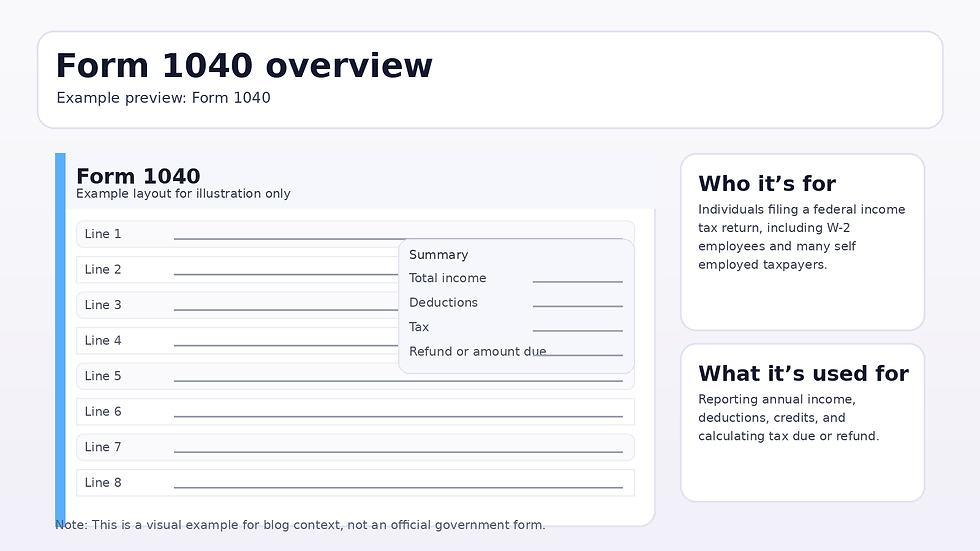
Form 1040 is the main federal tax return most individuals file each year to report income, claim deductions and credits, and calculate tax due or refund. It is where everything gets reconciled, including withholding, estimated payments, and many credits.
Who uses it
W-2 employees, freelancers, retirees, and people with investment income commonly file Form 1040. Many small business owners file it too because business income often flows through to the owner’s personal return.
What it is used for in real life
Form 1040 is the final scoreboard for your tax year. If too little was withheld or paid, you may owe. If too much was withheld, you may receive a refund. Filing issues often happen when supporting documents and schedules are incomplete or when reported income does not match what payers reported.
Common add ons people miss
Depending on your situation, Form 1040 may include schedules for itemized deductions, business income, self employment tax, capital gains, or other items. Even if you use filing software, it helps to understand what schedules exist so you can gather the right records.
Internal link area
· Internal link: Form 1040
· Internal link: Form 1040 instructions
· Internal link: Related schedules and add ons for Form 1040
Official IRS resources
· About Form 1040: https://www.irs.gov/forms-pubs/about-form-1040
· Form 1040 PDF: https://www.irs.gov/pub/irs-pdf/f1040.pdf
· Forms and instructions search for Form 1040: https://www.irs.gov/forms-instructions-and-publications?find=form+1040&page=0
Form W-2: Wage and Tax Statement
Form W-2 reports wages paid to an employee and the taxes withheld during the year. Employers provide it to employees and also report it to the government.
Who uses it
Employees use the W-2 to complete Form 1040. It is the official summary of wage income and withholding for that job.
What it is used for in real life
A W-2 is not just your earnings. It also documents federal withholding and often state and local withholding. That is why a missing W-2 can delay filing even if you know roughly what you earned. The numbers on the W-2 are what the IRS expects to see on your return.
Common issues and what to do
If a W-2 is incorrect or missing, start by contacting the employer or payroll provider. If a correction is needed, an employer can issue a corrected wage statement. Keep copies of any corrected forms with your records.
Internal link area
· Internal link: Form W-2
· Internal link: How to read Form W-2
· Internal link: What to do if your W-2 is missing or incorrect
Official IRS resources
· About Form W-2: https://www.irs.gov/forms-pubs/about-form-w-2
· Form W-2 PDF: https://www.irs.gov/pub/irs-pdf/fw2.pdf

Form W-4: Employee’s Withholding Certificate
Form W-4 is completed by an employee so the employer can withhold the correct amount of federal income tax from paychecks. It is not a tax return and it is not the same thing as a W-2.
Who uses it
Employees fill out the W-4. Employers use it to calculate withholding in payroll.
What it is used for in real life
The W-4 is your main tool for steering withholding. It can help prevent a balance due at filing time and can also reduce overwithholding if you prefer more take home pay during the year. It can account for multiple jobs, dependents, other income, deductions, and extra withholding.
When people typically update it
People often update the W-4 after life changes like marriage, a second job, having a child, or a meaningful income change. If you had a surprise tax bill or a much larger refund than expected, reviewing your W-4 is a practical first step.
Internal link area
· Internal link: Form W-4
· Internal link: W-4 guidance for employees
· Internal link: W-4 guidance for employers
Official IRS resources
· About Form W-4: https://www.irs.gov/forms-pubs/about-form-w-4
· Form W-4 PDF: https://www.irs.gov/pub/irs-pdf/fw4.pdf
· Topic no. 753 on Form W-4: https://www.irs.gov/taxtopics/tc753

Form 1099-NEC: Nonemployee Compensation
Form 1099-NEC is used to report nonemployee compensation, most commonly payments to independent contractors.
Who uses it
Businesses issue 1099-NEC forms to contractors when required. Contractors use them to help report income on their tax return.
What it is used for in real life
A 1099-NEC is a sign the payer treated you as a contractor, not an employee. If you are a freelancer, gig worker, consultant, or run a small service business, this is one of the most common forms you will see.
What it means for the recipient
Contractors typically report this income as business income and track related expenses. Good recordkeeping matters, including invoices, receipts, mileage logs, and payment statements. Clean records also make it easier to respond if a payer later issues a correction.
Internal link area
· Internal link: Form 1099-NEC
· Internal link: 1099-NEC explained for contractors
· Internal link: 1099-NEC explained for businesses that pay contractors
Official IRS resources
· About Form 1099-NEC: https://www.irs.gov/forms-pubs/about-form-1099-nec
· Form 1099-NEC PDF: https://www.irs.gov/pub/irs-pdf/f1099nec.pdf

Form 1099-MISC: Miscellaneous Information
Form 1099-MISC is used to report certain types of miscellaneous income, such as rents, royalties, and some prizes and awards.
Who uses it
Businesses and payers use it to report specific categories of payments. People and businesses who receive those payments use it to help report income accurately.
What it is used for in real life
This form often shows up with rental income paid through a business arrangement, royalty payments, or certain awards. Because different boxes represent different categories, it is worth reading it carefully rather than assuming it is contractor income.
A common point of confusion: 1099-NEC vs 1099-MISC
Contractor services are generally reported on Form 1099-NEC, while Form 1099-MISC is typically used for other categories like rents and royalties. If you are unsure which one applies, check what type of payment the box is describing.
Internal link area
· Internal link: Form 1099-MISC
· Internal link: 1099-MISC categories and examples
· Internal link: 1099-MISC vs 1099-NEC
Official IRS resources
· About Form 1099-MISC: https://www.irs.gov/forms-pubs/about-form-1099-misc
· Form 1099-MISC PDF: https://www.irs.gov/pub/irs-pdf/f1099msc.pdf
· Instructions for Forms 1099-MISC and 1099-NEC: https://www.irs.gov/instructions/i1099mec

Extra forms that come up a lot and why they matter
The forms above are the ones most people search for by name. The forms below drive many filing questions for small businesses, employers, and anyone earning money outside a single W-2 job.
Form W-9: Request for Taxpayer Identification Number and Certification
Form W-9 is used to provide your correct taxpayer identification number to a person or business that may need to file an information return reporting payments to you.
Why it matters
Businesses often request a W-9 before paying a contractor so they can prepare tax reporting later. In most cases, the requester keeps the W-9 on file.
Official IRS resources
· About Form W-9: https://www.irs.gov/forms-pubs/about-form-w-9
· Form W-9 PDF: https://www.irs.gov/pub/irs-pdf/fw9.pdf

Form 1099-K: Payment Card and Third Party Network Transactions
Form 1099-K reports payments processed through payment cards and many payment apps or online marketplaces.
Who runs into it
Online sellers, gig workers paid through platforms, and businesses that accept card payments may receive a 1099-K.
What people misunderstand
A 1099-K often reflects gross payment volume, which can include fees, refunds, or non income items. Your own records are still needed to determine taxable income accurately.
Official IRS resources
· About Form 1099-K: https://www.irs.gov/forms-pubs/about-form-1099-k
· Understanding your Form 1099-K: https://www.irs.gov/businesses/understanding-your-form-1099-k

Schedule C: Profit or Loss From Business (Sole Proprietorship)
Schedule C is commonly used to report income or loss from a business operated by a sole proprietor. Many freelancers and small service businesses use it to report business income and claim ordinary business expenses.
Practical recordkeeping tip
Treat Schedule C as an annual business summary. Consistent income and expense categories make it easier to file and easier to understand your results from year to year.
Official IRS resources
· About Schedule C: https://www.irs.gov/forms-pubs/about-schedule-c-form-1040
· Schedule C PDF: https://www.irs.gov/pub/irs-pdf/f1040sc.pdf

Schedule SE: Self Employment Tax
Schedule SE is used to calculate self employment tax on net earnings from self employment. It applies no matter how old you are and even if you already receive certain benefits.
Official IRS resources
· About Schedule SE: https://www.irs.gov/forms-pubs/about-schedule-se-form-1040
· Schedule SE PDF: https://www.irs.gov/pub/irs-pdf/f1040sse.pdf

Form 941: Employer’s Quarterly Federal Tax Return
Form 941 is used by employers to report federal income tax withheld from employees and the social security and Medicare taxes related to payroll.
Why it matters
If you run payroll, this reporting is part of your compliance rhythm. Even a small team benefits from a reliable process because it ties to payroll deposits and quarter end reporting.
Official IRS resources
· About Form 941: https://www.irs.gov/forms-pubs/about-form-941

Form 940: Employer’s Annual Federal Unemployment Tax Return
Form 940 is used to report annual federal unemployment tax. If you are an employer, confirm your payroll setup accounts for this filing.
Official IRS resources
· About Form 940: https://www.irs.gov/forms-pubs/about-form-940

Form 1065 and Schedule K-1: Partnerships and multi member LLCs
Form 1065 is used to report partnership activity. Schedule K-1 reports each partner’s share of income, deductions, and credits.
Why it matters to owners
K-1 timing and accuracy matter for planning, especially when the business has profits but does not distribute cash to owners. Keep K-1s with your tax records each year.
Official IRS resources
· About Form 1065: https://www.irs.gov/forms-pubs/about-form-1065
· Schedule K-1 PDF: https://www.irs.gov/pub/irs-pdf/f1065sk1.pdf


Form 1120 and Form 1120-S: Corporations and S corporations
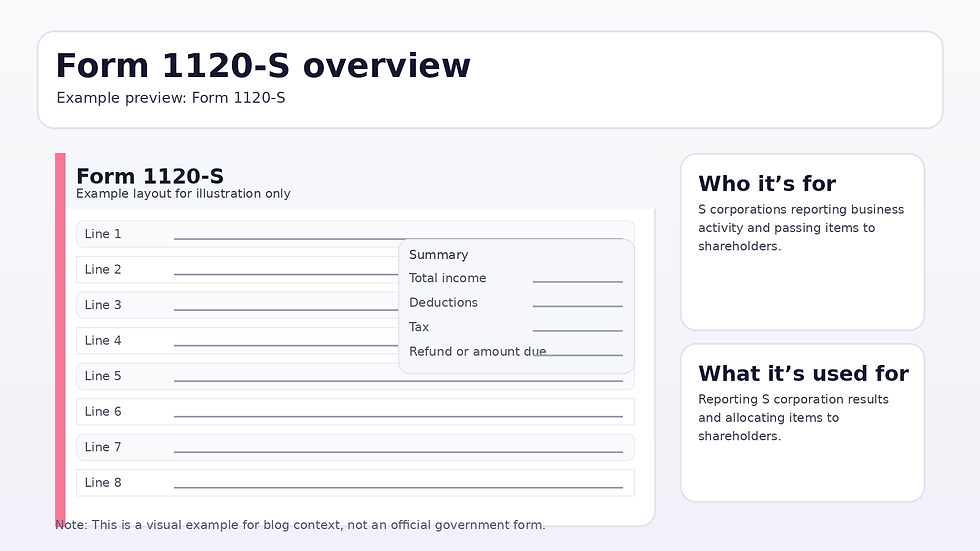
Form 1120 is used by corporations to report income, deductions, and calculate corporate income tax. Form 1120-S is used by S corporations to report business activity and pass through items to shareholders.
Why this matters for growing businesses
As a business becomes more formal, filings, deadlines, and documentation often increase. Understanding the form type helps owners set up the right bookkeeping and support.
Official IRS resources
· About Form 1120: https://www.irs.gov/forms-pubs/about-form-1120
· About Form 1120-S: https://www.irs.gov/forms-pubs/about-form-1120-s

Form 1040-X: Amended return
Form 1040-X is used to amend a previously filed individual tax return when you need to correct or update information.
When it comes up
People amend returns to fix missing forms, correct income, change deductions, or claim a credit they were eligible for after the original filing.
Official IRS resources
· About Form 1040-X: https://www.irs.gov/forms-pubs/about-form-1040x

Choosing the right form starts with how you earn money
If you want a clean mental model, start with how you are paid. Employees are paid through payroll, receive a W-2, and file Form 1040. Contractors are paid outside payroll, often receive a 1099-NEC, and still file Form 1040, usually with business reporting. Platform payments may trigger a 1099-K. Employers who run payroll have additional reporting responsibilities.
Frequently asked questions
What is the difference between W-2 and W-4
A W-4 is filled out by the employee so the employer can calculate withholding. A W-2 is the year end statement that reports wages and withholding.
What is the difference between 1099-NEC and 1099-MISC
Form 1099-NEC is used for nonemployee compensation, typically contractor pay. Form 1099-MISC is used for other categories like rents and royalties.
Can I file taxes with only my W-2
Many people can, but not everyone. If you have other income, deductions, credits, or self employment activity, you may need additional forms or schedules to file accurately.
I received a 1099 but I think I should have been an employee
A 1099-NEC generally means the payer treated you as an independent contractor. If that does not match how the work relationship actually functioned, it can create tax and compliance issues.
Final note
Tax forms are tools, not tests. The goal is to match your real world income and business activity to the correct paperwork. If your situation is complex or you are unsure how a form applies to you, consider reviewing official guidance or speaking with a qualified tax professional
*This content is provided for general informational purposes only. We are not tax professionals, and we do not provide tax, legal, or accounting advice. While we aim to keep information accurate, tax laws, IRS guidance, forms, and filing requirements may change without notice, and any summaries, examples, checklists, or downloadable files may be outdated, incomplete, or contain errors. You are solely responsible for confirming the current form version, instructions, and eligibility rules directly through official government sources before using any form or filing a return. For advice tailored to your specific situation, consult a licensed tax professional, CPA, or attorney.
Comments